
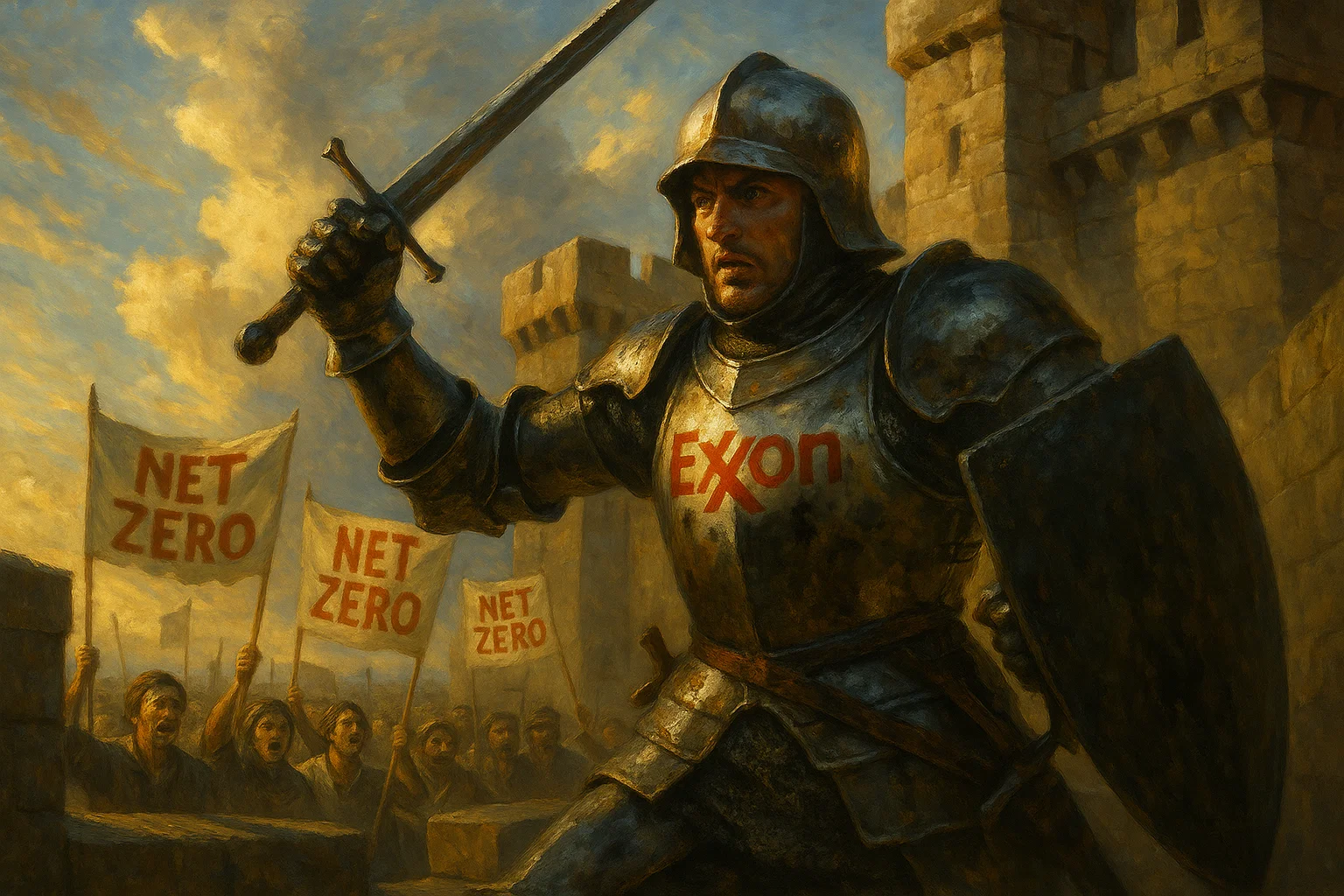
ExxonMobil’s Warning Shot: Texas Cuts Through the ESG Fog

For more than a decade, the ESG movement has operated like a shadow legislature — hijacking the shareholder proposal system to force companies into adopting political agendas that have nothing to do with profitability or fiduciary duty. But in 2024, something broke. ExxonMobil did what no major corporation had ever done: it hauled two ESG activist firms, Arjuna Capital and Follow This, into federal court and demanded a legal halt to their climate proposal.
It was the first real shot fired in what may become a long and bitter war.
Arjuna and Follow This had submitted a resolution demanding that Exxon adopt accelerated emissions targets — including the holy grail of climate activists, scope 3 reductions. Exxon didn’t just reject the proposal. It called it what it was: a political instrument masquerading as shareholder oversight. A tool not designed to create value, but to impose ideology.

Exxon’s filing in a Texas federal court made that point explicit. The proposal “does not seek to enhance ExxonMobil’s economic performance or create shareholder value.” It seeks to coerce the company into aligning with a political vision foreign to its business model and detrimental to its shareholders.
That statement alone shattered years of corporate appeasement.
And then came the real shock: even after Arjuna and Follow This withdrew their proposal, Exxon pressed forward. This wasn’t merely about blocking one resolution; it was about exposing an entire apparatus. Exxon wanted a court to rule that activists who buy token shares cannot hijack the machinery of corporate governance to force ideological compliance.
The ESG cartel panicked.
In May 2024, a federal judge allowed Exxon to proceed with its claims against Arjuna (though Follow This escaped on jurisdictional technicalities). Suddenly, the activists were faced with the one thing they feared most: legal discovery and judicial scrutiny.
That was enough to make them fold.
Arjuna ultimately issued an “unconditional and irrevocable” promise not to file similar proposals again — effectively tapping out. With the immediate conflict neutralized, the court dismissed the case.
But the dismissal wasn’t a defeat for Exxon. It was proof that the lawsuit had already accomplished its purpose.
By dragging activists into court, Exxon demonstrated that ESG coercion is not cost-free. There is now reputational, financial, and legal risk attached to the ESG playbook. The activists blinked. They backed down. And the entire movement took note.
The importance of this moment cannot be overstated.
For years, ESG proponents operated with impunity, believing companies would never push back. That illusion is gone. Exxon’s lawsuit — even in dismissal — stands as the first serious attempt to disrupt the ESG machinery at its point of capture: the shareholder proposal pipeline. It signals a new era in which corporations may no longer passively absorb activist demands but instead challenge them in court, in legislatures, and in the regulatory arena.
The venue matters, too. Exxon chose Texas for a reason. It is one of the few jurisdictions in America not yet captured by ESG orthodoxy — a state where the economic reality of energy production is understood, and where judges are less likely to treat activist demands as sacred writ.

The message is unmistakable:
If ESG activists want to use corporate governance as a political weapon, they may now face real consequences.
The ESG movement thrives on social pressure and bureaucratic leverage, not legal strength. When forced into the bright light of judicial review, it withers. Exxon proved that.
The case is over. The implications are not.
Every company that still produces real value — energy, food, manufacturing, logistics, metals, infrastructure — should take note. The ESG machine is vulnerable. It is rattled. And it can be resisted.
ExxonMobil fired the first shot. Others should follow.
